Solar Net Metering & Prosumer Registration in Pakistan Everything You Need to Know

Connecting your solar system to the WAPDA grid and registering as a prosumer is one of the most financially important steps in your solar journey and one of the most paperwork-intensive. Pakistan’s net metering framework has undergone significant changes in 2026 under NEPRA’s new Prosumer Regulations. Regal Solar Solutions keeps every customer fully informed of the current regulatory landscape and manages the complete prosumer registration process from application preparation to bi-directional meter installation as a standard part of every solar installation, at no additional charge.

Key Facts About Net Metering in Pakistan

net metering of solar system in pakistan

What Is Solar Net Metering And What Has Changed in Pakistan?

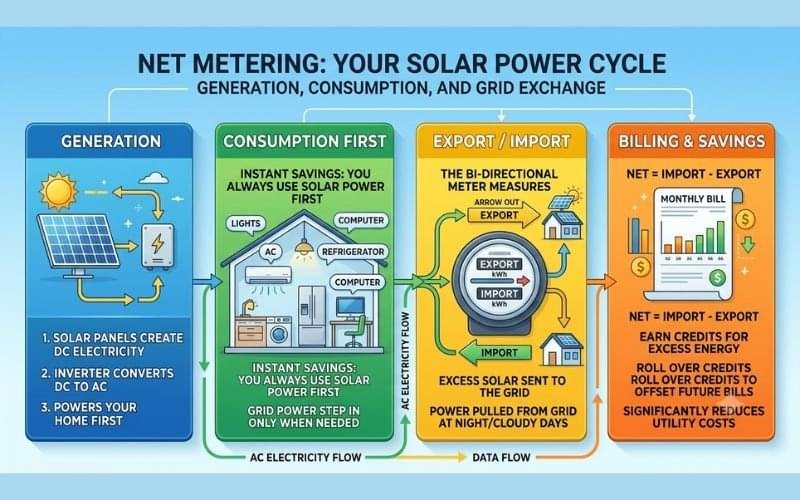
Solar net metering is a WAPDA billing arrangement that allows your solar system to export surplus electricity to the national grid, earning you credits that offset the electricity you consume from the grid at night or on cloudy days. Under Pakistan’s original Net Metering Regulations 2015, these exports were credited on a one-to-one unit basis meaning one kilowatt-hour exported earned you one kilowatt-hour of consumption credit, regardless of when it was used. This one-to-one arrangement made solar financially very attractive for Pakistani homeowners and businesses and drove the installation of over 7,000 MW of net-metered solar capacity across the country by early 2026.

In February 2026, NEPRA formally notified the NEPRA (Prosumer) Regulations 2026, replacing the 2015 net metering framework with a net billing system. Under net billing, the one-to-one unit exchange is no longer available. Instead, electricity you export to the grid is purchased by your DISCO at the national average energy purchase price currently in the range of Rs. 11 to Rs. 27 per unit while electricity you consume from the grid continues to be billed at your applicable consumer tariff, which can be Rs. 40 to Rs. 70+ per unit. This means the financial benefit of exporting surplus electricity to the grid has been significantly reduced compared to the previous arrangement.

Despite this regulatory change, solar remains a highly sound financial investment for Pakistani homeowners, businesses, and industries with one important strategic adjustment. The financial priority is now to maximize self-consumption of your solar generation rather than export. This means correctly sizing your system to match your actual load, considering battery storage to shift consumption to hours when solar is generating, and avoiding deliberate oversizing intended for grid export revenue. Regal Solar Solutions designs all new systems under the Prosumer Regulations 2026 framework, ensuring your system is optimized for maximum self-consumption and genuine long-term savings not a financial model that no longer applies.

NEPRA Process

Step-by-Step NEPRA
Net Metering Process

NEPRA has a defined regulatory framework for net metering. SolarPak guides you through every step — and handles most of it on your behalf.

NEPRA net metering application process Pakistan
2–4 Weeks
Average approval time
About NEPRA

National Electric Power Regulatory Authority

NEPRA is Pakistan's federal electricity regulator, established under the NEPRA Act 1997. In 2015, NEPRA introduced the Net Metering Regulations, allowing consumers to interconnect renewable energy systems with the national grid and receive credit for surplus electricity they export.

The regulations apply to all DISCOs (Distribution Companies) including LESCO, GEPCO, FESCO, MEPCO, IESCO, PESCO, QESCO, HESCO, SEPCO, and K-Electric in Karachi.

NEPRA Net Metering Regulations 2015 (Amended 2022)
Legal framework governing all solar net metering connections in Pakistan
Application Steps
1
Site Survey & System Design
Day 1
SolarPak's AEDB-certified engineer visits your site. Roof assessment, shading analysis, load calculation, and system sizing. A formal quotation and single-line diagram (SLD) is prepared.
Free of Cost Within 24 Hours
2
Installation & Commissioning
Day 2–4
Solar panels, inverter, mounting structure, and wiring are installed. System is tested and commissioned. DC/AC protection devices are installed as per NEPRA safety standards.
1–3 Days AEDB Certified
3
Application to DISCO
Day 5
SolarPak submits your complete net metering application to your local DISCO (LESCO, GEPCO, IESCO, etc.) with all required documents, single-line diagram, and interconnection agreement.
SolarPak Handles This
4
DISCO Technical Review
1–2 Weeks
The DISCO technical team reviews your application, verifies system specifications, and conducts a site inspection to ensure compliance with NEPRA grid interconnection standards.
DISCO's Responsibility We Follow Up
5
Bi-Directional Meter Installation
Week 2–3
After approval, the DISCO installs a bi-directional (smart) meter at your premises. This replaces your existing meter and records both import and export units separately.
DISCO Installs One-time Meter Cost
6
Net Metering Active!
Week 3–4
Your net metering connection is live. From your next billing cycle, exported units are credited against your consumption. Start seeing near-zero electricity bills from month one!
Savings Begin!
Key Regulations to Know
System Size Limits

Net metering is available for systems from 1kW to 1,000kW (1MW). Residential systems typically range from 5kW–25kW. No upper limit on number of panels as long as total capacity stays within 1MW.

Export Rate (Buy-Back Rate)

Under NEPRA regulations, exported units are credited at the the same rate as the consumer tariff for residential and small commercial consumers. Industrial consumers may have a separately agreed rate.

Annual Settlement

Any excess export credits not offset during the year are settled annually by the DISCO as a cash payment or carried forward, depending on your DISCO's policy.

Safety Requirements

NEPRA requires an anti-islanding inverter (grid-tie) that automatically disconnects during load-shedding — protecting DISCO workers repairing lines. All SolarPak installations are fully compliant.

SolarPak Handles Everything

From DISCO application to bi-directional meter installation follow-up — SolarPak manages the entire NEPRA net metering process for you at no additional charge.
How to Sell Your Surplus Energy Back to WAPDA

With NEPRA’s shift from one-to-one net metering to net billing, the strategy for maximizing your solar return has changed. The four principles below are what Regal Solar Solutions designs every new system around ensuring our customers get the best possible financial outcome under the current regulatory framework.

Prioritize Self-Consumption Over Export

Under net billing, every solar unit you consume directly saves you the full retail tariff rate (Rs. 40–70+ per unit). Every unit you export earns you only the national average purchase price (Rs. 11–27 per unit). The financial priority is therefore clear consume as much of your solar generation as possible within your premises. This means running high-consumption appliances (ACs, water heaters, washing machines, pumps) during peak solar hours (10 AM to 4 PM) to maximize direct solar consumption and minimize grid reliance during the day.

Right-Size Your System for Your Actual Load

One of the most important changes under the new prosumer framework is that deliberate oversizing for export revenue is no longer financially justified. Under the 2015 one-to-one net metering regime, installing a larger system than your immediate consumption could earn strong export credits. Under net billing, surplus generation is sold at a fraction of retail cost. Regal Solar Solutions sizes every new system precisely to your actual load profile ensuring maximum self-consumption and avoiding over-investment in generation capacity that will earn reduced export returns.

Add Battery Storage for Maximum Self-Consumption

Battery storage has become more financially compelling under the Prosumer Regulations 2026. By storing surplus solar generation in batteries instead of exporting it to the grid at the lower purchase price, you shift that stored energy to your evening and nighttime consumption saving the full retail tariff rate instead of earning the lower export rate. For homeowners and businesses with significant nighttime consumption, a hybrid solar system with battery storage now offers substantially better financial returns than an on-grid export-only approach. Regal Solar designs hybrid systems optimized for maximum battery utilization under the current billing framework.

Understand Your Annual Net Billing Settlement

Under the Prosumer Regulations 2026, your DISCO settles your net billing account annually. Any unused export credits accumulated throughout the year are settled at the end of the annual period against your consumption account. Understanding how your DISCO calculates this annual settlement and ensuring your meter readings are accurate is important for claiming full value from your prosumer connection. Regal Solar provides guidance on reading and interpreting your prosumer bill, and supports customers in raising billing disputes with their DISCO where meter readings or settlement calculations appear incorrect.

solar-system-installation-in-pakistan

Pro Tips for Maximizing Solar Savings Under Pakistan’s Prosumer Regulations 2026

Run your highest-consumption appliances during solar hours (10 AM – 4 PM) air conditioners, water geysers, washing machines, pumps, and electric cooking to consume solar directly at zero per-unit cost rather than drawing from the grid in the evening.

Choose a hybrid solar system with battery storage if your consumption is higher at night than during the day. Batteries allow you to store your daytime solar surplus and use it in the evening at full tariff savings value instead of exporting it at the lower purchase price.

Monitor your monthly DISCO bill carefully after prosumer registration. Ensure that your exported units are being recorded correctly and that the buyback rate applied matches NEPRA’s current published national average energy purchase price. Contact Regal Solar if any billing discrepancy appears.

Do not oversize your solar system under the current prosumer framework. A system larger than your sanctioned load will not be approved for prosumer registration. A system larger than your average consumption will generate surplus that earns only the lower export purchase price reducing your overall system ROI compared to a correctly sized installation.


Keep your prosumer agreement documents safely stored. Your 5-year contract specifies your export rate, billing terms, and annual settlement procedure. These documents are important for any future billing disputes, DISCO changes, or contract renewal negotiations.

Register for your DISCO’s online customer portal after prosumer activation. Most DISCOs including LESCO, GEPCO, and IESCO provide online bill access where prosumer generation and export data can be tracked monthly giving you visibility into your system’s financial performance without waiting for your paper bill.


Documents Required for Prosumer Registration in Pakistan

Regal Solar Solutions prepares all technical documents on your behalf. You need to provide the following personal and utility documents to complete your prosumer application submission.

SolarPak Document Assistance

We prepare all technical documents, SLD, and application forms free of charge as part of your installation package.

solar-system-installation-in-pakistan

Complete Document Checklist

Documents You Provide


Documents Regal Solar Prepares


Frequently Asked Questions

The original one-to-one net metering framework under the NEPRA Net Metering Regulations 2015 has been replaced by a net billing system under the NEPRA (Prosumer) Regulations 2026, notified in February 2026. Under net billing, surplus electricity you export to the grid is purchased at the national average energy purchase price rather than credited at a one-to-one unit rate. Solar energy remains financially very beneficial the strategy has shifted from export-focused to self-consumption-focused. Regal Solar designs all new systems to maximize self-consumption under the current framework.

Under the NEPRA (Prosumer) Regulations 2026, electricity exported to the WAPDA grid is purchased at the national average energy purchase price, which NEPRA sets based on the national average power procurement cost. As of 2026, this rate is approximately Rs. 11 to Rs. 27 per unit significantly lower than the retail tariff rate of Rs. 40–70+ per unit that consumers pay for grid electricity. This is why maximizing self-consumption is now more financially important than maximizing export.

NEPRA's 2026 regulations formally shifted all prosumers including existing ones to the net billing framework. However, the Power Minister stated in the Senate that existing prosumers bound by 7-year contracts would not be significantly affected until their contract terms expire. The situation has been politically contested and may be subject to further clarification. Regal Solar recommends all existing net metering customers review their prosumer agreement terms and contact their DISCO for confirmation of their current billing status. We assist existing customers with this review at no charge.

The prosumer registration process typically takes 4 to 12 weeks from application submission to bi-directional meter installation, depending on your DISCO's processing load and NEPRA's concurrence timeline. LESCO and IESCO in Islamabad tend to process applications faster than some other DISCOs. Regal Solar actively follows up throughout the process and keeps customers informed of application status. We submit all applications immediately after system installation  delays in submission are never a factor on our end.

Regal Solar Solutions has successfully completed prosumer registrations with LESCO (Lahore), GEPCO (Gujranwala), IESCO (Islamabad), FESCO (Faisalabad), MEPCO (Multan), and K-Electric (Karachi). We are familiar with each DISCO's specific documentation requirements, technical inspection preferences, and application processing procedures which vary significantly between DISCOs and can make a real difference to how quickly your application is approved.

Regal Solar Solutions handles the complete prosumer registration application including all technical document preparation, DISCO submission, follow-up, and inspection coordination as a standard part of every solar installation, at no additional charge. The only cost you incur is the NEPRA processing fee of Rs. 1,000 per kW of installed capacity, which is payable to NEPRA directly as part of the application. This fee is not charged by Regal Solar.

Yes. Both commercial and industrial electricity consumers can register as prosumers under the NEPRA (Prosumer) Regulations 2026 for solar systems up to 1 MW in capacity. Commercial and industrial applications require additional documentation including NTN certificates, business registration, and DISCO industrial connection documentation. Regal Solar manages the complete prosumer registration process for residential, commercial, and industrial customers across all applicable DISCOs.

Prosumer application rejections are usually due to documentation gaps, technical non-compliance of the installed system, or exceeding the sanctioned load capacity. Because Regal Solar prepares all technical documentation to NEPRA standards and ensures systems are compliant before submission, rejection rates for our customer applications are extremely low. In the rare case of a rejection, we identify the specific grounds, remedy the issue, and resubmit the application at no additional charge to the customer until approval is obtained.

Get a Free Quote